Algorithm parameters
Model and design structure
In this tab, you can select the model you would like to study in your experiment and the structure (number of runs) to consider. In Minitab DOE by Effex, you can generate candidate designs with different numbers of runs in a single calculation.
For Model of interest, there are three choices:
- Main effects (first-order effects only). Recommended for screening experiments.
- Main and interaction effects (first-order effects and two-factor interactions). Recommended for optimization experiments when all factors are categorical or when you are not interested in estimating curvature effects.
- Main and second-order effects (first-order effects, two-factor interactions, and quadratic effects). Recommended for optimization experiments when you want to estimate the quadratic effects of quantitative factors.
The design structure depends on the type of design: a standard design, a design with hard-to-change factors, or a design with a blocking factor.
Standard designs without extra complications
For number of runs, a range can be specified using the two text boxes. The text box to the left can be used to set the lower limit for the number of runs, and the text box to the right can be used to specify the upper limit.
Designs with hard-to-change factors
When one or more factors have a reset difficulty other than Easy, the software considers a split-plot design (see Design description). For example, a design might include factors with reset difficulties of Hard+2, Hard+1, and Easy, as shown below.
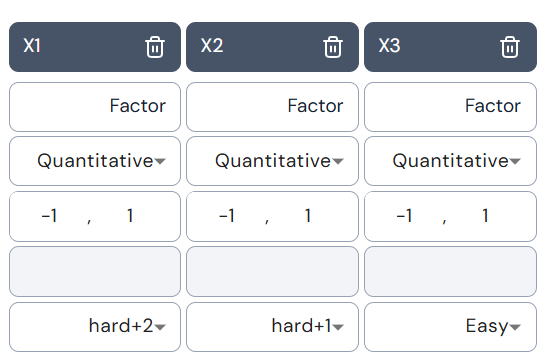
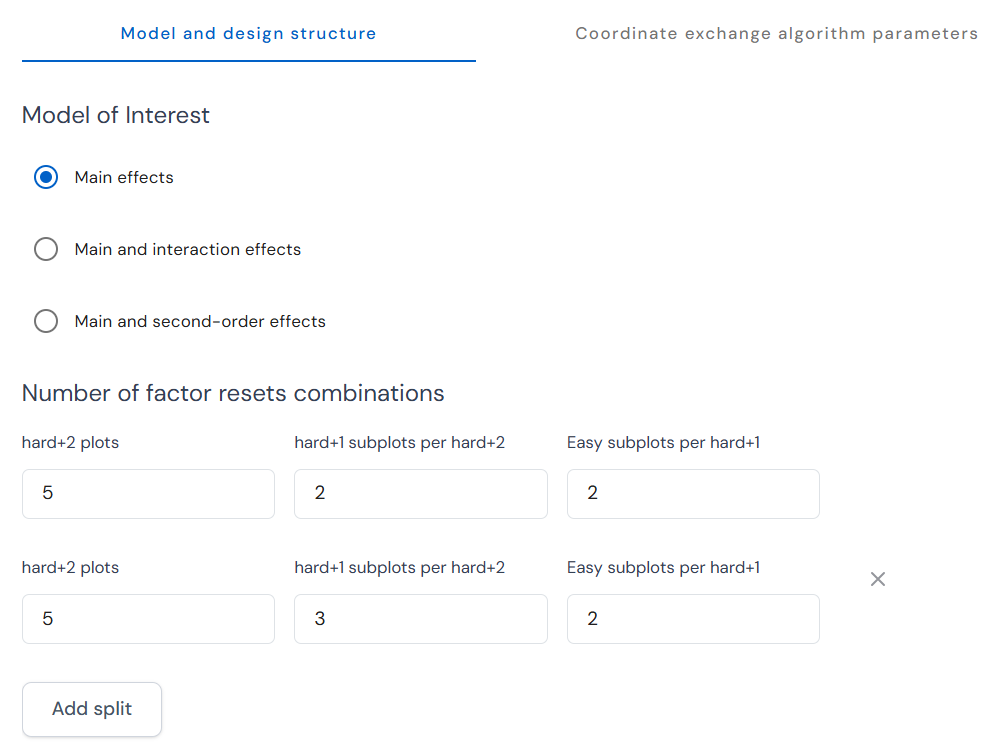
The number of runs in each candidate design depends on three values: the number of whole plots, the number of subplots per whole plot, and the number of runs per subplot. Enter these values in the form. To consider alternative configurations, click Add split to add a row where you can enter different values for each number.
The total number of runs is the product of these three values:
- With 5 whole plots (Hard+2 plots), 2 subplots per whole plot (Hard+1 subplots per Hard+2 plot) and 2 runs per subplot (Easy subplots per Hard+1 subplot), the design has $5 \cdot 2 \cdot 2=20$ runs.
- In the second case, the design has $5 \cdot 3 \cdot 2=30$ runs.
Designs with a blocking factor
When the Blocking toggle is active, the model includes an additional blocking factor as a fixed effect. When Random Block Effects (Advanced) is active, the blocking factor is included as a random effect. This distinction is important when determining the minimum number of runs required to fit the model of interest.
Background information on fixed and random blocking factors (click to unfold)
Experimental runs are often organized into groups. Runs may differ by day, batch, operator, or machine. Including a blocking factor accounts for this unavoidable variation in the statistical analysis. Identification of blocking factors:
- Runs cannot be conducted under identical conditions.
- Operational constraints require runs to be split across times, batches, equipment, or other groups.
- A nuisance factor is expected to influence one or more responses.
- You need to generalize conclusions beyond a single group. Benefits of using blocking factors
- Separates nuisance variation from treatment effects.
- Improves precision by reducing residual variance.
- Helps avoid misleading conclusions.
- Makes experiments more practical.
- Improves reproducibility and transferability.
- Supports better decisions in studies with multiple responses.
The choice between fixed and random blocks affects both optimal design generation and optimization. The table summarizes the implications of each type of blocking factor.
| Block type | Fixed blocks | Random blocks |
|---|---|---|
| Nature | Block levels are specific levels of interest | Block levels are a sample from a larger population of possible blocks |
| Modeling | Modeled as separate parameters | Modeled as a variance component |
| Optimization | Applies to specific block levels | Generalizes across the wider population of blocks |
The minimum number of runs depends on:
- The selected model of interest
- Whether the blocking factor is fixed or random
- The maximum block size
For both types of blocking factor, the total number of blocks is calculated as follows:
$\text{Number of blocks} = \left\lceil \frac{\text{n runs}}{\text{Max block size}} \right\rceil$, where $\left\lceil \cdot \right\rceil$ is the ceil function, which returns the smallest integer greater than or equal to its argument.
For a fixed blocking factor, $\text{Number of blocks}-1$ dummy variables are needed to model the blocks. The minimum number of runs is increased by this same amount.
For a random blocking factor, one additional run is needed to estimate the variance component associated with the blocks. We recommend using a minimum of five blocks. Although the software allows designs with as few as two blocks, these designs may not provide enough information to reliably estimate the variation between blocks
Coordinate exchange algorithm parameters
In the tab Coordinate exchange algorithm parameters, you can specify the optimality criteria that is of interest and the number of random starts.
For the Optimality criteria, there are three choices: D-optimal, A-optimal and I-optimal
All three criteria are selected by default. However, you can choose to uncheck the criteria that are not relevant for your experiment.
Page last modified on 21 October 2026