Projection properties
While a design may not allow the estimation of a full second-order effects model, it may allow the estimation of a large subset of the effects, so that it is suitable for a screening + optimization experiment at the same time. Second-order models for subsets of factors.
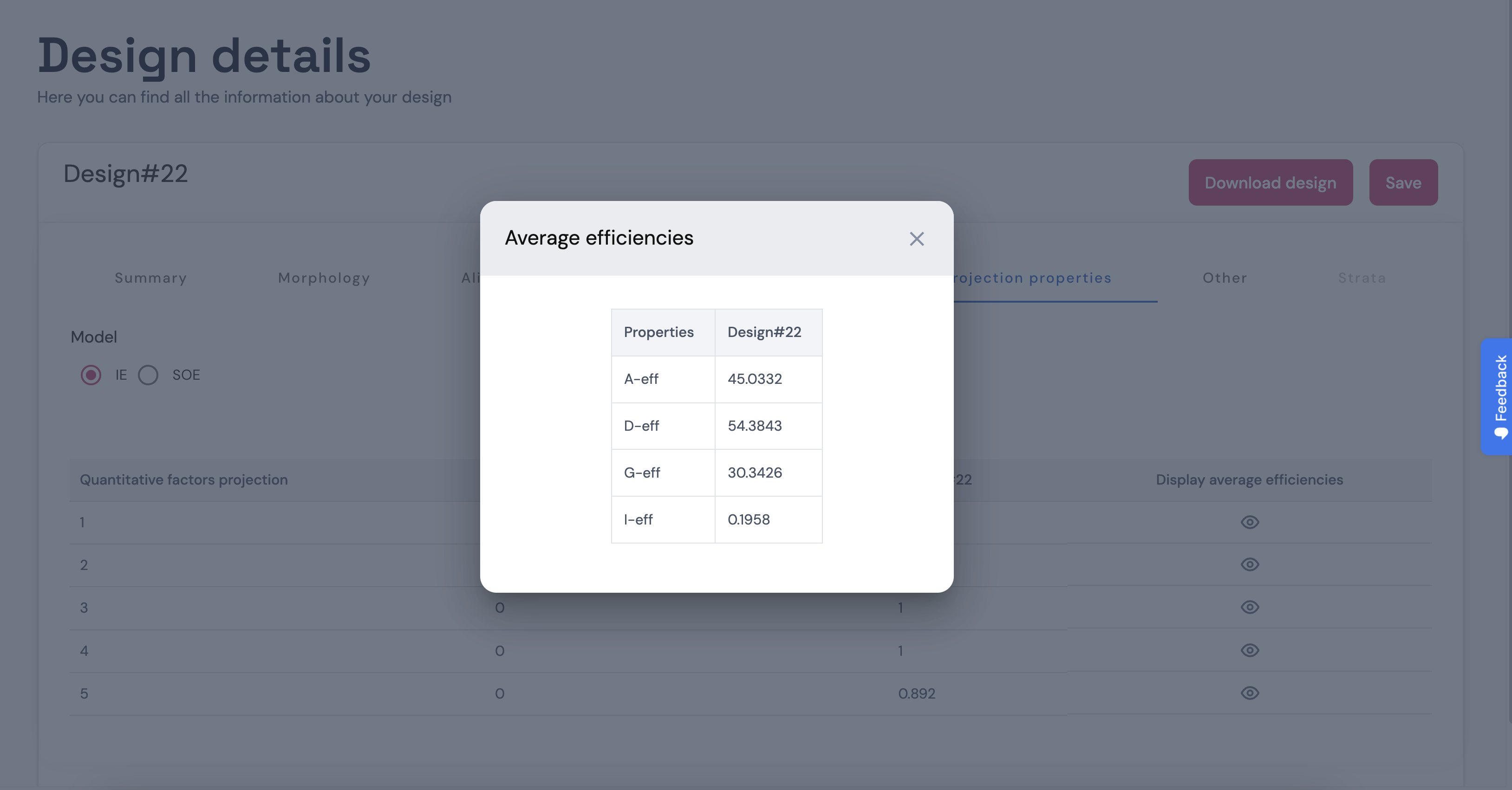
This page offers details on the estimation quality of second-order models based on subsets of the factors. For any subset, these models include an intercept, all the main effects, all the two-factor interactions, and all the quadratic effects of the numerical three-level factors in the subset.
- The numbers of numerical three-level factors in the subsets are specified in the first column of the table.
- The numbers of two-level factors are specified in the table’s second column.
- The third column displays the so-called projection estimation capacity for up to three designs that are to be compared. This is the fraction of estimable models for the numbers of numerical three-level factors and two-level factors specified in the first and second columns, respectively.
- The last column contains clickable buttons that produce, for each subset with the numbers of two-level and three-level factors specified in the first two columns, the average D-efficiencies and A-efficiencies. Further characteristics are the averages of (1) the maximum prediction variance and (2) the average prediction variance over 500 randomly chosen combinations of two-level and three-level factors.
- The combinations of the two-level factors are randomly chosen from the full factorial design in the specified number of two-level factors. The combinations of the three-level factors are randomly chosen from between the low and high levels.
- As the maximum prediction variance is often located at the edges and corners, a few of such points are added to the 500 random points.