Advanced options
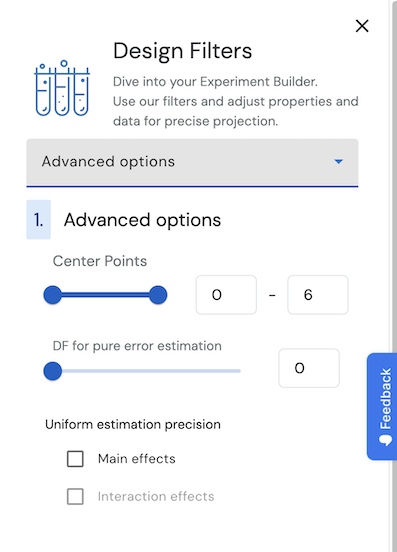
Center points, pure error and uniform precision designs
-
A center point is a design point where all the three-level factors are set at their middle level. The slider designated ‘Center Points’ allows you to specify a range of numbers of such points.
-
The slider designated DF for pure error estimation allows you to specify the minimum number of degrees of freedom for a model-free estimate of the random error. This number is determined as the number of runs minus the number of distinct points of the design. If you want to base the statistical tests solely on the model-free estimate, a minimum of 3 DF for pure error estimation is recommended.
- If the design includes only three-level factors, including two or more center points allows for model-free estimation of the random error, also called pure error estimation. The corresponding number of degrees of freedom is one less than the number of center points. If the design includes additional two-level factors, the number of center points is the total over all the combinations of two-level factors. In that case, including more than one center point may or may not allow for pure error estimation.
-
There are two check boxes to specify conditions on the number of runs at the middle level of the three-level factors. Checking the box Main and quadratic effects ensures that the number of runs at the middle level of any numerical three-level factor is the same. This ensures a roughly equal precision for the main effects and for the quadratic effects in models with just these effects.
-
Checking the box Interaction effects ensures that, for any pair of numerical three-level factors, the number of runs where one or both of the factors attain their middle level is the same. This ensures an equal precision for the interaction effects in all models with main effects and a single interaction effect.